Few roles in cricket have evolved as much over the decades as the team coach.
In 2024, during another one of those utterly forgettable bilateral T20I series between India and Sri Lanka, SonyLIV (the official Indian broadcasters) ran a most singular promo. While the banner did feature cricketers, the largest faces were reserved for the two new coaches and retired stars, Sanath Jayasuriya and Gautam Gambhir. It was unheard of in a country where cricketers are worshipped as demi-gods and coaches were perceived as the head support cast.
That year, 2024, was also during the peak of clamour regarding Bazball, an approach that divided opinion and inspired books, and a word that found its way into the Collins English dictionary. Over its four-year life cycle, it was almost forgotten that the label was named after the coach, not the captain.
In 2026, these things may seem insignificant. Thanks to the constantly mushrooming T20 leagues, fans have become used to the idea of the celebrity coach. The IPL, the alpha and omega of city-based franchise leagues, debuted with eight high-profile coaches who were followed by television cameras throughout the tournament. And why not? Lalit Modi had modelled the IPL on the NBA, which boasted of celebrity coaches like Pat Riley and Phil Jackson.
However, it would be wrong to credit franchise leagues with the idea of cricket team coaches. They were there before as well, but keeping in tune with its inherent rigidity, cricket was overall late to the party. “Every other sport knelt at the altar of the coach, manager or guru,” noted Gideon Haigh in the 2006 Wisden Almanack. “In cricket, despite a technical rigour and complexity that begat so many instructional books, the captain remained all-powerful.”
The Early era
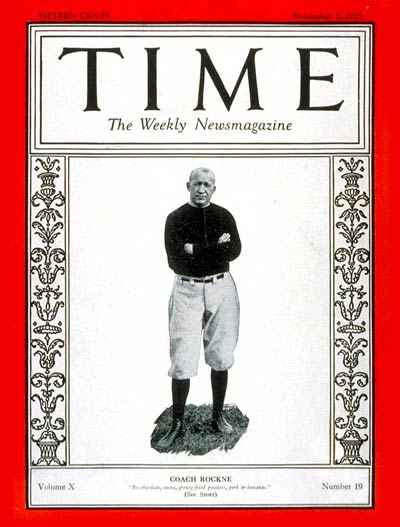
One can see Haigh’s point. In 1927, legendary American football coach Knute Rockne appeared on the cover of the Time magazine, showcasing how other sports were open to celebrating the idea of the all-powerful coach. Yet cricket was far more resistant. Two years later, “ten former Test players” wrote to the New South Wales Cricket Association to argue against their plans for employing a professional coach. The ex-players wrote that “the natural Australian freedom of style might be sacrificed by the introduction of orthodox teachings”.
The cricket coaches which did exist at that time worked at an individual level. The most famous of them was perhaps Alf Gover, whose South London coaching school had Ken Barrington, Frank Tyson, Viv Richards, and Sunil Gavaskar among its alumni. Three of Ramakant Achrekar’s students – Sachin Tendulkar, Vinod Kambli, Pravin Amre – featured in the same India XI.
At the team level, Surrey had WT Grayburn and Melbourne Cricket Club had Charles Lawrence in the pre-War era. Later, George Hirst coached at Yorkshire, while Steve Doughty was in charge of their Second XI. But all of this was only at the club level. Sometimes the retired professional would double as ground-staff and net practice in-charge. But for most clubs, and particularly at the international level, it was accepted that the captain should be the go-to man in a Test team. The senior cricketers mentored the youngsters, and that was that.
Of course, the players didn’t tour alone. Boards used to send tour managers along with them – ambassadorial, authoritative figures who managed things on and off the field. They handled logistics and daily allowances, conducted fielding practice sessions and doubled up as net bowlers, prepared end-of-tour conduct reports, and so on. It was an approach that reflected the ethos of that relatively amateur era. For example, sometimes there would be two managers, like England’s during the Bodyline series.
Some of them were strategists, working hand in hand with the captains. South Africa captain Jack Cheetham and manager Ken Viljoen laid out a blueprint ahead of the times. They got rugby great Danie Craven to design a fitness regime; instilled military discipline; analysed rudimentary video reels and scoring charts; and used concrete surfaces to mirror Australian conditions. After they returned with a 2-2 draw from Australia in 1952/53, the board requested the duo to document it all for the next generation – the “Vil-Cheet Plan”. But the Viljoens were exceptions rather than the rule, and their successful approach didn’t catch on for decades.
The beginning of the change
It took something significant for a cricket team to adopt a coach. That came when Australia lost two series against New Zealand, home and away, in the same season in 1985/86. This called for drastic measures.
The board first approached Ian Chappell, but he did not feel cricket teams needed coaches. So they went to Bobby Simpson, who had come out of retirement to lead when Australia’s best had left for Kerry Packer’s World Series Cricket. Simpson felt Australia needed a coach because of the “diminishing role of the Australian captain and the almost total destruction of peer influence within Australian cricket” thanks to Packer.
Simpson thus became international cricket’s first long-term Test coach. Sri Lankan fans may object to this claim, for Garry Sobers had indeed coached them in 1982 and 1983, their first years in Test cricket, when he famously fought with the selectors to pick a schoolboy Arjuna Ranatunga. But it was not a long-term appointment.
For the Test coach to work, the first of them had to succeed. And Simpson did succeed. He joined hands with Allan Border to help a team in transition win their first World Cup in 1987, then win 4-0 in England to regain the Ashes in 1989. He was still there in 1994/95 when Australia became the first team in a decade and a half to beat the West Indies in a Test series. He had transformed them to the unofficial Test champions, and launched an era of absolute dominance.
England offered Micky Stewart a similar role in 1986 (though as a “team manager”). In Gower: The Autobiography, the England captain admitted to being unimpressed by Stewart’s “soccer-manager style of bullshit” as well as the ten o'clock bedtime. It was a curious statement from Gower, given how football managers Brian Clough and Tommy Docherty had been as popular as any footballer in the country. But perhaps it spoke to cricket’s continued suspicion of the role of the head coach during this era.
Gower’s successor Mike Gatting warmed up to Stewart, as did his teammates. But it was not until Duncan Fletcher’s appointment in 1999 that England had a coach who would find sustained success. A former Zimbabwean World Cup captain, Fletcher arrived with Western Province and Glamorgan on his coaching CV and immediately impressed new captain Nasser Hussain: “I thought he would be coming to me saying, ‘What’s he like?’ … I soon realised Duncan knew everything about everyone.”
Six years later, Fletcher became the first Test cricket coach to be honoured with an OBE. He was also awarded UK citizenship, but this had precedent: Bangladesh’s qualification for the 1999 World Cup had earned Gordon Greenidge an honorary citizenship status in the country.
Fletcher was part of a 1990s trend of cricket boards recruiting overseas coaches. Former England Test cricketer Bob Woolmer was as synonymous to South Africa’s rise in the 1990s as was the Australian Dav Whatmore to Sri Lanka’s World Cup glory in 1996 – though, to be fair, Whatmore was born in Sri Lanka.
That decade also witnessed unprecedented advancements in television coverage, especially super slow-motion cameras. This was supported by the advancements in computer programs. Woolmer, working with sports scientist Tim Noakes, was a pioneer in this regard, vastly expanding and formalising the type of analysis coaches would be expected to provide.
In his seminal book Woolmer on Cricket, he spoke of his dream of “a dossier of dismissals for all players in Test match cricket, at the touch of a button to be able to tell the bowlers where the best area to bowl would be and what types of pitches these batsmen liked to bat on”. The great visionary was describing concepts from 2026 in the 1990s. All this, after the South African board had asked him to “stick to the basics of coaching”.
But let us return to Fletcher. In October 1999, the month when England appointed Fletcher, Australia took another big leap by hiring John Buchanan, a specialist bat with a first-class average of 12 and no international experience. His career as a cricketer was vastly inferior to those he was expected to coach, which included legends like Steve Waugh, Glenn McGrath, and Shane Warne.
The appointment predictably divided opinions. Warne famously dismissed the idea, saying “I’m a big believer that the coach is something you travel in to get to and from the game”. But the captain Waugh and his successor Ricky Ponting acknowledged Buchanan’s importance, for he elevated ( an admittedly already strong) Australian side to one of the greatest cricket teams in history.
His stint was in stark contrast to India’s in the same year. Coach Kapil Dev and captain Tendulkar, touted as a match made in heaven, turned out to be a short-lived disaster, but even there it led to a transformative appointment. Within a year, India ended up appointing John Wright as their first foreign coach.
It underlined a significant point: a great coach need not have been a great cricketer. None of Buchanan, Tim Nielsen, Graham Ford, Andy Moles, Trevor Bayliss, Adrian Birrell, or Mickey Arthur were international cricketers. Mike Hesson did not even play domestic cricket, yet all of these names have found a lot of success as head coaches.
Perhaps the real turning point came after the epic Ashes series of 2005. Ponting, the losing captain, famously lamented that “it’s a pity that we didn’t have any expert coaches to help our guys out,” while praising England for being “well managed, well skilled” and having “planned well”. It led to almost immediate change, as three months later, Australia appointed Troy Cooley as bowling coach. Cooley had been with England during the Ashes, and his appointment as a specialist skills coach meant that the deuteragonist finally got his screen time.
By this point, Woolmer had moved to Pakistan, while India had transitioned from Wright to Greg Chappell. After the next Ashes, England would replace Fletcher with another Zimbabwean, Andy Flower. But cricket had already taken the next step: the word “coach” now applied to not only an individual but an entire staff. As Australia’s capture of Cooley suggested, all of them were sought after.
Is the broth being spoiled? Perhaps not.
Today’s teams come with a support cast that has specialist coaches for batting, fielding, and bowling (superspecialists, in fact, for some teams have spin- and pace-bowling coaches). There are strength and conditioning coaches and high-profile sports doctors and throwdown specialists. Analysts are near-mandatory as well (how Woolmer would have loved it!). Add to that the very vague role of “mentor”, usually reserved for a celebrity former cricketer. Half a century ago, all these myriad responsibilities came under the manager’s job description.
The supremo of this entire cast goes under the title of the head coach, a figure as central to a contemporary team’s image and performance as the captain, and held just as accountable for its failures. But just as significant is how the most celebrated of them have adjusted to the balance between the high-pressure circuits of league cricket and internationals.
Some, like Phil Simmons, Jason Gillespie, Whatmore, Arthur, Stuart Law, and Moles, have preferred coaching international sides, punctuated only by brief forays into franchise cricket. In contrast, the likes of Ricky Ponting, Daniel Vettori, Tom Moody, Lance Klusener have largely been T20-only coaches, similar to the kind of role Flower has settled into since leaving his England job.
But T20 franchises have loyalists as well. Over the years, Ashish Nehra and Adam Voges have been synonymous with Gujarat Titans and Perth Scorchers. Stephen Fleming had been the same for the Super Kings franchise (in the IPL and beyond) for almost two decades, until he recently succeeded Brendon McCullum as the England Test head coach.
As it stands, coaches for modern sides are on their way to becoming as fluid as modern cricketers. With coaches moving between teams and formats, teams like Surrey, England, or RCB already have directors of cricket in place.
Cricket’s transition from a paternalistic jack-of-all-trades manager to a professional board of coaches has taken its time. As the sport gets more professionalised, coaches are dedicated to every aspect of its myriad skillsets. This increasing specialisation has led to the demand for the CEO-type head coach who can manage the rapidly increasing support staff and connect them to the director of cricket..
The scenario makes many yearn for simpler times, but a professional structure is intrinsic to excellence in any field. Cricket has already been late to the party: it is important to not slide back to amateurism.
Follow Wisden for all cricket updates, including live scores, match stats, quizzes and more. Stay up to date with the latest cricket news, player updates, team standings, match highlights, video analysis and live match odds.